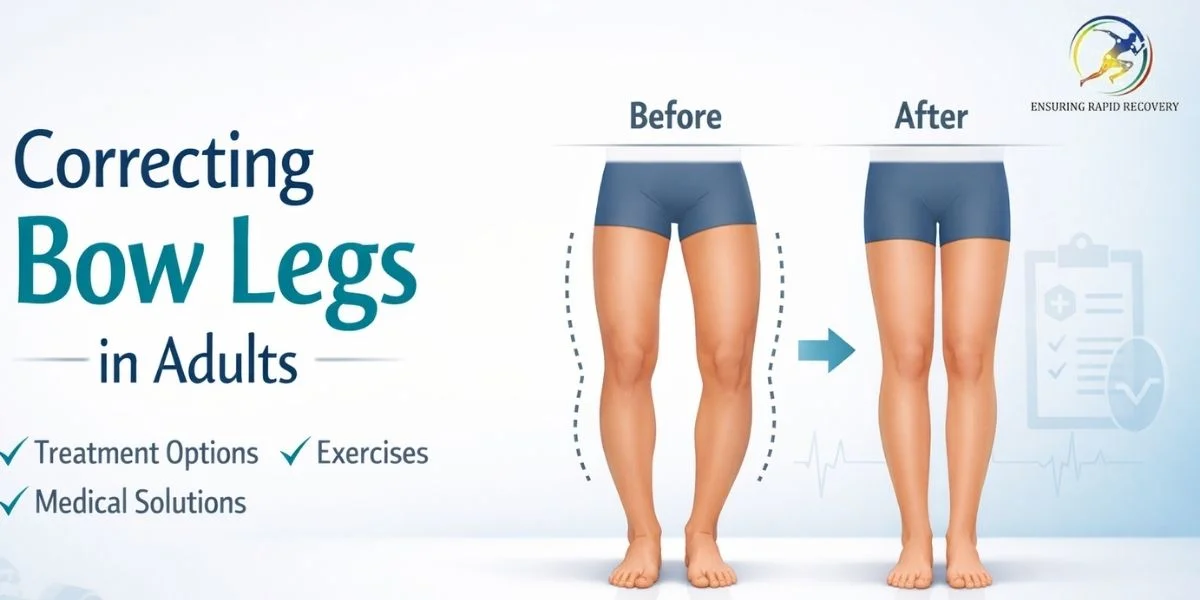
If you’ve started noticing that your legs don’t stay straight while standing, you’re not alone. Many adults slowly discover an outward curve in their legs over time and begin searching for answers, like how to correct bow legs in adults or how to fix bow legs.
Medically, this condition is called bow legs (bowed legs) or genu varum, where the weight of the body shifts unevenly across the knees due to a change in bone alignment. It falls under lower limb deformity, and it can range from a mild cosmetic concern to a condition affecting walking comfort.
Before jumping into solutions, many patients first consult the best orthopedic surgeon in Delhi for proper evaluation. Experts like Dr. Saksham Mittal help identify whether the issue is structural, nutritional, or joint-related. Now, let’s understand what actually happens inside the body.
Why Do Bow Legs Happen in Adults?
People often search for why bow legs happen, and the answer is rarely a single factor.
In adults, bow legs usually develop gradually due to changes in bone or joint structure:
1. Uneven Knee Load
When pressure on the inner knee increases over the years, the joint slowly shifts outward, creating varus deformity.
2. Cartilage Wear
The knee cartilage acts like a cushion. Once it wears down, bones start changing alignment naturally.
3. Nutritional Weakness
Long-term vitamin D deficiency or calcium deficiency can weaken bone strength, especially if not addressed early.
4. Old Injury Effects
A fracture that didn’t heal perfectly can slowly affect bone alignment.
5. Progressive Joint Disease
Conditions like arthritis often change walking patterns and contribute to leg curvature.
Think of it like a door hinge that slowly loosens over time, it doesn’t break suddenly; it shifts gradually.
Also Read: Knock Knee: The Ultimate 360° Guide for Causes, Symptoms, Diagnosis, and Treatment
How to Check Bow Legs at Home (Simple Test)
If you’re wondering how to check bow legs, here’s a simple method:
- Stand straight on a flat surface
- Keep ankles together
- Look at the gap between your knees
A small gap may be normal, but a wide visible separation could suggest bowed legs.
Still, self-check is not a diagnosis. A proper clinical evaluation is always more reliable.
Is Bow Legs Normal or a Medical Concern?
A common question is: are bowed legs normal in adults?
The answer depends on severity:
- Mild curvature → sometimes harmless
- Moderate to severe curvature → may indicate joint or bone imbalance
In adults, visible bowing is usually not considered “normal alignment” because it may affect long-term knee health and walking efficiency.
Can Bow Legs Be Corrected?
Yes, in many cases, can bow legs be corrected is a realistic expectation.
However, correction depends on:
- Age
- Cause
- Severity
- Joint condition
Early-stage cases respond better than long-standing structural deformities.
How to Correct Bow Legs in Adults (Main Treatment Approaches)
Let’s break down the real-world options for how to correct bow legs in adults.
1. Physiotherapy and Muscle Training
One of the first steps in bow leg treatment is physiotherapy.
It focuses on:
- Strengthening inner thigh muscles
- Improving gait abnormality
- Supporting bone alignment
- Reducing knee stress
Exercises alone cannot reshape bones, but they improve function and reduce discomfort.
2. Lifestyle and Posture Correction
Small daily changes matter:
- Weight management reduces knee pressure
- Proper footwear improves balance
- Avoiding uneven walking habits helps alignment and stability
This falls under non-surgical treatment approaches.
3. Bracing Support (Selective Cases)
In some cases, braces help guide alignment and reduce stress on the knee joint. This is more effective in early or flexible deformities.
4. Surgical Correction (For Severe Cases)
When deformity becomes structural, surgical correction may be required.
Doctors realign the bone to restore proper posture and load distribution. This is often recommended when pain or deformity affects daily life.
At this stage, consultation with the best orthopedic surgeon in Delhi becomes important to evaluate options safely.
How to Fix Bow Legs Without Surgery
Many people specifically search for how to fix bow legs in adults without surgery.
Non-surgical methods include:
- Physiotherapy programs
- Strength training
- Joint mobility improvement
- Weight control
- Medical monitoring
However, these methods work best in mild cases. They improve symptoms more than structural shape.
Can Bow Legs Be Corrected Naturally?
The phrase how to correct bow legs naturally is very common online.
Natural approaches may help:
- Improve muscle balance
- Reduce pain
- Support posture
But it’s important to understand:
Natural methods do not fully reverse structural bone changes in adults.
When Should You Take It Seriously?
You should consult a specialist if:
- Knee pain increases over time
- Walking feels uneven
- Legs curve visibly worse
- Fatigue appears during standing or walking
In such cases, a Joint Specialist Doctor in Delhi or an orthopedic expert can guide the next step.
Medical Terms You Should Know
Understanding reports becomes easier if you know these:
- bow legs / bowed legs
- genu varum
- varus deformity
- lower limb deformity
- bone alignment
- knee misalignment
- limb alignment correction
- orthopedic treatment
These terms often appear in diagnosis reports.
Conclusion: Don’t Ignore the Early Signs of Bow Legs in Adults
Bow legs are not necessarily a significant issue in adults. Mostly, they grow slowly and without noise until some discomfort sets in.
The encouraging fact is that the current bow leg treatment has various options- physiotherapy to surgical correction according to necessity.
Not sure what is wrong with you, then do not take guesses or random Internet suggestions. The right assessment by the best orthopedic surgeon in Delhi, such as Dr. Saksham Mittal, would provide you with a clear picture.
It is always better to treat and prevent complications at an earlier stage.
In case you are having any symptoms or you simply need to be evaluated accordingly, then give us a call or make an appointment at our clinic. Depending on your condition, our team can help you know what to do next.