
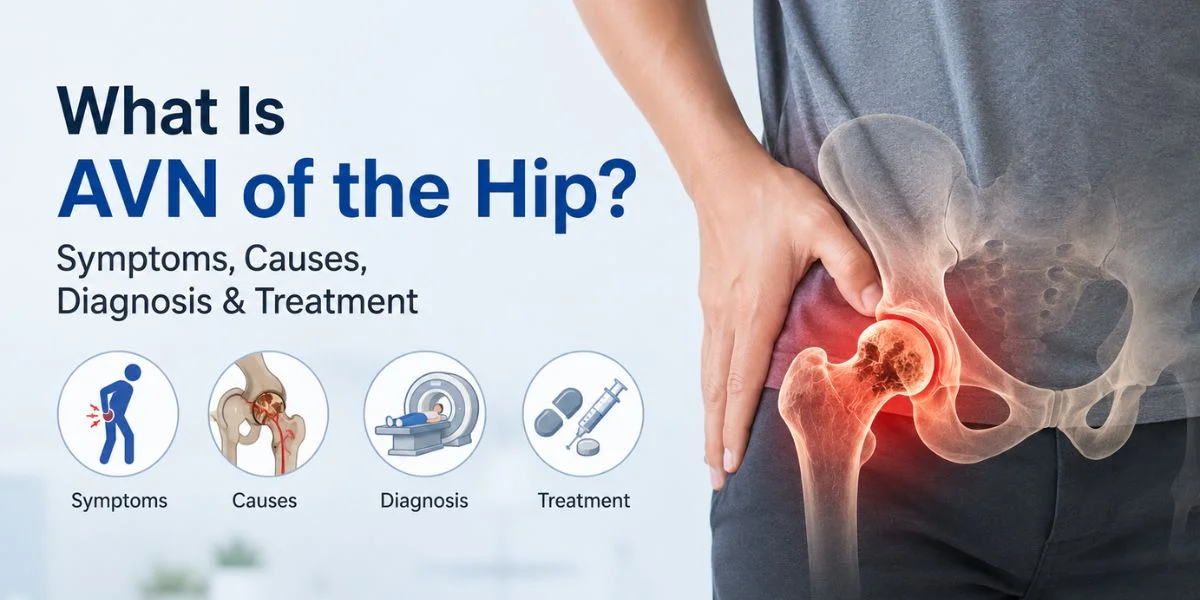
If you are searching for AVN hip joint, you may have come across terms such as AVN of hip, osteonecrosis, or femoral head necrosis and wondered what they actually mean. If persistent hip pain is affecting your daily life, an orthopedic evaluation can help determine the cause and whether you may need a hip replacement surgeon in Delhi.
AVN is a condition in which reduced or interrupted blood supply damages bone tissue, most commonly the femoral head in the hip. Without appropriate management, the weakened bone can eventually collapse and damage the hip joint.
The good news? Early diagnosis can make a meaningful difference in treatment planning. Let’s break down AVN without turning your hip into a medical textbook.
What Is AVN of the Hip?
AVN full form in medical terminology is Avascular Necrosis. It is also called osteonecrosis of the femoral head when it affects the hip.
So, when someone asks, What is AVN hip joint?, the simple answer is: AVN occurs when part of the femoral head does not receive enough blood supply, causing bone tissue to become damaged or die.
The hip joint connects the femur to the acetabulum, the socket within the pelvis. The rounded femoral head normally moves smoothly inside this socket, with articular cartilage helping the joint move with minimal friction.
When AVN develops, reduced blood flow can affect the bone beneath this cartilage. As the disease progresses, the femoral head may weaken, develop structural damage, and eventually collapse.
That explains terms such as AVN in hip joint, hip joint AVN, and AVN hip full form; they all point toward the same underlying condition when AVN affects the hip.
What Causes AVN in the Hip?
Understanding the cause matters because treatment should address more than the pain itself.
AVN can develop after an injury that disrupts blood vessels supplying the bone. Long-term or high-dose corticosteroid use and excessive alcohol consumption are also established risk factors. Certain medical conditions, including sickle cell disease, lupus, and antiphospholipid syndrome, can also affect blood flow to the bone.
Also Read: Total Hip Replacement (THR): A Complete Guide to the Procedure
Common Risk Factors
Some recognized factors include:
- Long-term corticosteroid use
- Excessive alcohol consumption
- Hip fracture or dislocation
- Certain blood disorders
- Autoimmune conditions
- Radiation treatment
- Some cancer treatments
- Conditions affecting blood clotting or circulation
Sometimes doctors cannot identify a definite cause. This is known as idiopathic osteonecrosis.
Because several factors can contribute to AVN, a comprehensive assessment is important before deciding on treatment.
AVN Hip Joint Symptoms
Symptoms can vary according to the stage and extent of bone damage. Some people have no symptoms during the early stage, while others gradually develop pain and restricted movement.
Common symptoms include:
- Hip or groin pain
- Pain that may spread toward the thigh or buttock
- Pain while standing or walking
- Hip stiffness
- Reduced range of motion
- Difficulty with weight-bearing activities
- Increasing pain as the condition progresses
Mayo Clinic notes that AVN pain often develops gradually and may initially occur with weight-bearing. In more advanced disease, pain can also occur while resting or lying down.
This is why persistent hip discomfort should not automatically be blamed on age, exercise, or sleeping funny. Sometimes the hip is trying to tell you something rather important.
Normal vs AVN Hip Joint Comparison
A normal vs AVN hip joint comparison helps explain why early diagnosis matters.
| Normal Hip Joint | Hip With AVN |
| Healthy femoral head | Damaged femoral head |
| Adequate blood supply | Reduced or interrupted blood supply |
| Preserved bone structure | Areas of bone necrosis |
| Smooth weight-bearing surface | Possible structural weakening |
| Normal hip movement | Pain or restricted movement may develop |
| No femoral head collapse | Collapse can occur as disease progresses |
In early AVN, the femoral head may still maintain its shape. As the condition progresses, however, structural damage can lead to collapse and secondary arthritis.
How Is AVN of the Hip Diagnosed?
Diagnosis begins with your medical history and physical examination. Your doctor may assess hip movement, pain, walking ability, and risk factors.
Imaging then plays a major role.
X-Ray
An X-ray can show structural changes, but early AVN may not appear clearly on an X-ray. This means a normal X-ray does not always rule out early disease.
MRI
MRI is particularly useful for detecting early changes in the femoral head. Current evidence also supports MRI as a highly sensitive imaging method for osteonecrosis of the femoral head.
CT Scan and Bone Scan
A CT scan can provide detailed information about bone structure and may help identify subchondral fractures. A bone scan is another imaging option, although MRI is generally central to early evaluation.
Early and accurate diagnosis helps doctors understand the extent of disease and choose an appropriate treatment strategy.
Understanding AVN Stages
Doctors use classification systems to describe the severity of osteonecrosis. The Ficat-Arlet classification and ARCO staging system are commonly referenced in clinical literature. The revised ARCO system distinguishes pre-collapse disease from stages involving femoral-head depression and later joint destruction.
In simple terms, AVN can be thought of as progressing from early changes to more significant structural damage.
Early-Stage AVN
The femoral head remains structurally preserved. Patients may have limited symptoms, and imaging, particularly MRI, can reveal changes that X-rays miss.
This is the stage where early intervention and joint-preserving strategies may have the greatest relevance.
Advanced AVN
As bone damage increases, the femoral head can develop depression or collapse. Once the weight-bearing surface loses its shape, preserving the natural joint becomes more difficult.
The treatment decision therefore depends heavily on stage, lesion size and location, symptoms, age, activity level, and whether collapse has occurred.
What Is AVN Hip Joint Treatment?
There is no single AVN hip joint treatment that works for every patient.
Doctors choose treatment according to the stage of disease and whether the femoral head has collapsed.
Non-Surgical Management
For selected patients, doctors may recommend reducing weight-bearing, modifying activities, managing pain, and using physical therapy to maintain mobility.
These measures can help with symptoms and function, but they do not automatically restore the damaged blood supply or reverse established bone necrosis. Treatment needs to match the underlying stage of disease.
Core Decompression
Core decompression is a joint-preserving procedure generally considered for selected patients with early, pre-collapse disease.
The procedure removes a portion of damaged bone from inside the femoral head. The goal is to reduce pressure and encourage a healing response.
Evidence suggests core decompression has its strongest role in appropriately selected early-stage disease, although outcomes vary by stage and other patient factors.
Bone Grafting and Other Hip-Preservation Procedures
Depending on the case, surgeons may consider bone grafting, vascularized fibular grafting, or osteotomy. These procedures aim to preserve the femoral head in selected patients.
However, they are not suitable for every patient, particularly when substantial femoral-head collapse has already occurred.
Total Hip Replacement
When the femoral head has collapsed or the hip has developed significant joint damage, total hip arthroplasty, commonly called total hip replacement, may provide the most reliable solution.
Current literature continues to support total hip replacement as an important treatment for advanced, post-collapse osteonecrosis.
For patients researching hip replacement in Delhi, a consultation with an experienced orthopedic surgeon can help determine whether joint-preserving treatment remains possible or whether replacement is more appropriate.
When Should You See an Orthopedic Specialist?
Persistent groin or hip pain deserves attention, particularly if you have risk factors such as long-term corticosteroid use, significant alcohol exposure, previous hip trauma, or an associated medical condition.
Dr. Saksham Mittal provides orthopedic care with a focus on joint conditions and procedures, including hip-related treatments. A specialist evaluation can help establish whether your symptoms relate to AVN, arthritis, another hip disorder, or a different source of pain.
If imaging confirms AVN, stage-specific treatment is important. A small, early lesion and a collapsed femoral head are very different clinical situations, so treatment should never be chosen from an internet checklist.
Can AVN Be Prevented From Getting Worse?
Not every case can be prevented, but identifying and addressing modifiable risk factors may help reduce further risk.
Your doctor may review medication history, alcohol consumption, underlying medical conditions, and other potential contributors. Early diagnosis also allows closer monitoring and discussion of appropriate treatment before irreversible structural damage develops.
If you are considering hip replacement treatment, remember that replacement is not automatically the first treatment for every AVN case. In selected early cases, doctors may consider hip-preserving procedures instead.
AVN of the Hip: Key Takeaways and Treatment Options
AVN of the hip occurs when reduced blood supply damages the femoral head, potentially leading to bone collapse if the condition progresses. Early diagnosis, accurate staging, and personalized treatment can help determine the most appropriate care.
If you have persistent hip pain or have been diagnosed with AVN, contact Dr. Saksham Mittal today for a professional orthopedic evaluation and personalized treatment guidance. Get in touch with Dr. Saksham Mittal to discuss the right treatment approach for your condition.