
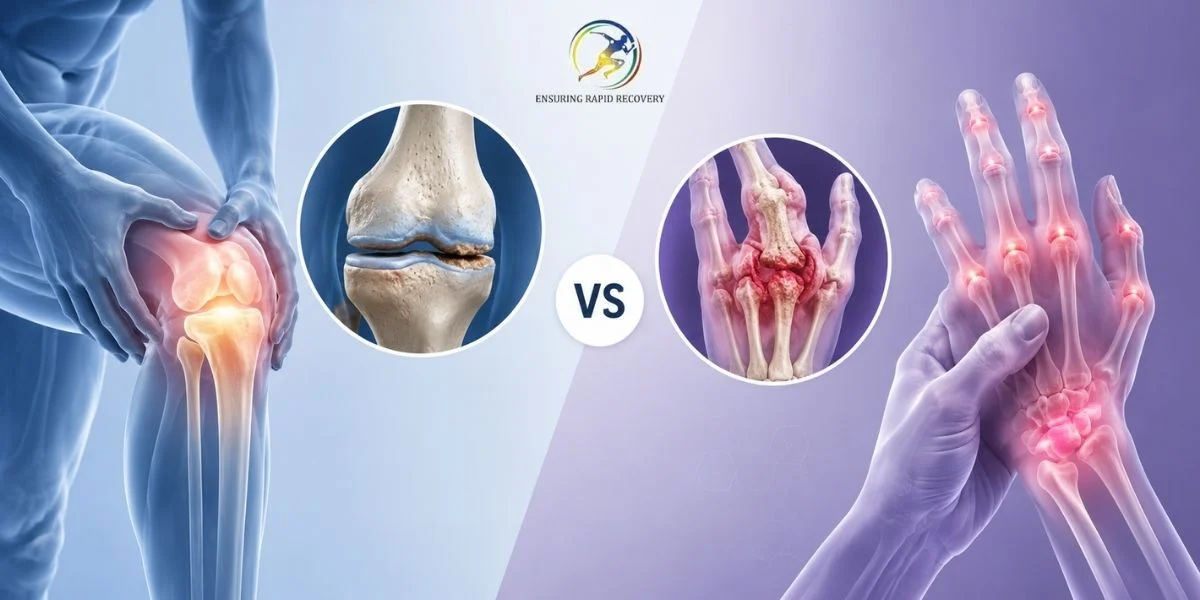
Joint pain has a funny way of making you feel twenty years older overnight. One day you’re fine, the next day your knees are filing a formal complaint every time you climb stairs. But here’s the catch: not all joint pain is created equal. Osteoarthritis vs Rheumatoid Arthritis is one of the most searched health comparisons for a reason: these two conditions look similar on the surface but behave very differently underneath.
If you’ve been Googling your symptoms at 2 AM (we’ve all been there), this guide will help you tell them apart, understand what’s actually happening in your joints, and know when it’s time to stop self-diagnosing and consult a Joints Specialist Doctor in Delhi.
What Is Osteoarthritis? The Wear and Tear Disease
Osteoarthritis (OA) is what most people picture when they think of arthritis. It’s the most common type overall, and it develops when the cartilage cushioning your bones gradually wears down over time. Think of cartilage as the shock absorber in your joints. Once it thins out, bones start rubbing closer together, and that’s when the stiffness, aches, and creaky-knee sound effects begin.
According to the CDC, osteoarthritis affects over 32 million adults in the U.S., including roughly 80% of adults over 55 It’s largely a degenerative joint disease, meaning it builds up slowly, usually over years rather than weeks. It commonly shows up later in life, often after age 60, and progresses gradually rather than suddenly.
Common risk factors include:
- Age (typical onset in the late 40s to early 50s, according to health researchers)
- Genetics: Some people simply inherit sturdier cartilage than others
- Excess body weight, since carrying extra load puts more pressure on weight-bearing joints
- Old joint injuries that never fully healed
The Centers for Disease Control and Prevention also notes that 20.9% of women were diagnosed with OA between 2019 and 2021, compared to 16.3% of men, so gender does play a role here, too.
Where Osteoarthritis Usually Strikes
OA has a preference for joints that carry your body weight, such as knees, hips, spine, and hands. It typically affects one joint at a time rather than several at once, unlike its autoimmune cousin. If your right knee aches after a long walk but your left one is perfectly fine, that asymmetry is a classic OA signature.
Also Read: Cricket and Football Knee Injuries: A Complete Guide for Delhi Athletes
What Is Rheumatoid Arthritis? When the Immune System Gets Confused
Rheumatoid arthritis (RA) plays by a completely different rulebook. It’s an autoimmune arthritis, which means your immune system, the body’s defence squad, mistakenly identifies your own joint tissue as a threat and attacks it. This mistaken attack causes chronic inflammation in otherwise healthy joint tissue. The result is joint inflammation that can flare up fast and spread to multiple joints at once.
Where Rheumatoid Arthritis Usually Strikes
Here’s where things get interesting, and where a lot of self-diagnoses go wrong. RA typically strikes small joints symmetrically, meaning both wrists or both hands at once, while OA tends to affect single joints asymmetrically. So if both your hands are stiff and swollen at the same time, that’s your body hinting at autoimmune arthritis, not simple wear and tear.
Osteoarthritis vs Rheumatoid Arthritis: The Symptom Showdown
Both conditions share a few surface-level arthritis symptoms, such as pain, swelling, and reduced mobility, which is exactly why people mix them up. But the details tell a different story.
Morning stiffness is one of the biggest tells. Rheumatoid arthritis symptoms typically involve prolonged morning stiffness, while osteoarthritis causes shorter-lived stiffness that tends to worsen later in the day. In plainer terms: if you wake up and your joints feel locked for over an hour, that leans toward RA. If they loosen up within twenty or thirty minutes of moving around, that’s more consistent with OA.
The number of joints affected matters too. RA usually causes pain in multiple joints at once, whereas OA tends to be most painful in a single joint.
RA can also throw in some full-body symptoms, fatigue, mild fever, and general I feel like I’m coming down with something malaise, because it’s a systemic condition, not just a local joint issue. OA, on the other hand, generally stays confined to the joint itself.
None of this replaces a real diagnosis, of course. Self-Googling only gets you so far, which is exactly why professional evaluation from the best orthopedic surgeon in Delhi matters, especially when symptoms overlap this much.
What Causes Cartilage Breakdown vs Immune Attacks?
Understanding the causes of arthritis is where OA and RA truly part ways.
Osteoarthritis results from the progressive breakdown of cartilage between joint bones, commonly associated with age-related wear and tear, though researchers still don’t fully understand every factor that triggers it. It’s mechanical damage, think of it like a well-used hinge that’s finally showing its age.
Rheumatoid arthritis, meanwhile, is rooted in immune dysfunction. RA develops when the immune system mistakenly attacks the joints, particularly the synovium, the lining that cushions and lubricates them. In simple terms, OA results from mechanical stress on the joints, while RA results from the immune system malfunctioning and attacking the body’s own tissues. That’s a fundamental difference: one is structural damage, the other is an internal misfire.
How Doctors Diagnose OA and RA
The diagnostic journey looks similar at first glance, which adds to the confusion. Doctors typically start with a medical history review and physical examination for both conditions, followed by imaging tests such as X-rays, MRI scans, CT scans, or ultrasounds.
The results, however, point in different directions. Imaging that shows reduced joint space or bone spurs usually points toward OA rather than RA. Blood tests are the real differentiator; blood tests cannot diagnose OA, but they can help detect markers associated with RA, since RA is driven by immune activity that shows up in bloodwork.
Timing matters enormously for RA specifically. The CDC recommends diagnosing rheumatoid arthritis within the first six months of symptom onset so treatment can begin early and slow the disease’s progression. Early awareness genuinely changes long-term outcomes here, which is why persistent joint stiffness or swelling shouldn’t be brushed off as just getting older.
Treatment Differences: Managing Symptoms vs Managing the Immune System
This is arguably the most practical section, because treatment approaches for OA and RA are built on entirely different foundations.
Osteoarthritis (OA) treatments basically aim at managing symptoms, as osteoarthritis (OA) has no cure; the damage caused by it to the joints cannot be reversed, although their symptoms can be minimized and treated. Common forms of this strategy consist of drug products such as acetaminophen, NSAID pain killers, duloxetine, together with physical therapy, weight loss, and joint replacement surgery in case the condition reaches the advanced stage. Non-prescription pain-relief medications, as well as non-steroidal anti-inflammatory drugs (NSAIDs) that come with the likes of ibuprofen, help many patients with their pain, aches, and swelling.
Rheumatoid arthritis. However, treatment, unlike OA, does not focus merely on the symptoms but on the immune system directly. This is a typical example of an autoimmune, also of the systemic type disease, so treatment would mostly entail drugs aimed at suppressing immune function and preventing the joints from being damaged again, alongside regular workouts and lifestyle changes for managing pain over the long term.
When the situation deteriorates and continues with either of these two diseases or in advanced cases, surgical treatments become serious options, and one has to be able to get guidance from a well-experienced surgeon. Dr. Saksham Mittal at Paschim Vihar is a recognized arthritis expert with 11 years of hands-on experience in joint restoration, including robotic knee replacement surgery, ACL reconstruction, knee arthroscopy, and other joint-related surgeries. Dr. Mittal gives a perfect mixture of modern precision robotic technology and the least invasive healing technique.
Why Getting the Right Diagnosis Actually Matters
Confusing OA and RA isn’t just a technicality; it can delay proper treatment and recovery. Since RA is progressive and immune-driven, delayed treatment allows it to cause more irreversible joint damage. OA, while slower-moving, still benefits enormously from early lifestyle changes that protect remaining cartilage.
If you’re experiencing unexplained chronic joint pain, swelling in multiple joints, or stiffness that doesn’t ease up, it’s worth consulting a specialist rather than guessing. Patients across Punjabi Bagh, Rajouri Garden, Bhera Enclave, Moti Nagar, Kirti Nagar, Pitampura, Vikaspuri, and Janakpuri increasingly search for a trusted orthopedic doctor in Punjabi Bagh or nearby areas precisely because early, accurate diagnosis leads to better long-term outcomes. Whether you need an orthopedic doctor in Rajouri Garden, specialized care closer to Janakpuri and Pitampura, timely consultation offers real relief, comfort, and a clearer path toward recovery.
Final Thoughts: Awareness Is the First Step Toward Relief
Osteoarthritis and rheumatoid arthritis, despite sharing the word “arthritis” in their names, have completely different disease mechanisms: one is essentially joint wear due to age and use, while in rheumatoid arthritis, the body’s own immune system attacks the joints. A clear understanding of the differences between the two about symptoms, reasons, medications & therapeutic modalities could go a long way toward making you a better patient.
If your bones have started to ache so that even a routine is affected, making an appointment at one of these times could be a crucial decision. Meet a very competent specialist for the first step, get to know his thoughts tailored to your case and follow his guidance for a treatment that will enable you to get back on your feet, maintain joint health and enjoy life actively yet confidently. Book your meeting by calling now.